12-inference-prediction
tidymodels
Suggested Reading
- Tidy Modeling with R Chapter 7: A Model Workflow
- The package itself has some worked examples: https://www.tidymodels.org/start/models/
Course Announcements
Due Dates:
- ⌨️ Lab 06 due Fri 11/6 (11:59 PM)
- 📄 Final Project Proposal due Sun
- 🔘 Lecture Participation survey “due” after class
Note: hw02 graded; feedback posted as Issue on GH
Agenda
- modelling (conceptually)
tidymodels- inference
- machine learning
Modelling
🧠 Discussion
- What is a model?
- How are models used in inference? In machine learning?
tidymodels: philosophy
“Other packages, such as caret and mlr, help to solve the R model API issue. These packages do a lot of other things too: pre-processing, model tuning, resampling, feature selection, ensembling, and so on. In the tidyverse, we strive to make our packages modular and parsnip is designed only to solve the interface issue. It is not designed to be a drop-in replacement for caret. The tidymodels package collection, which includes parsnip, has other packages for many of these tasks, and they are designed to work together. We are working towards higher-level APIs that can replicate and extend what the current model packages can do.” - Max Kuhn (
tidymodelsdeveloper)
. . .
Benefits:
- Standardized workflow/format/notation across different types of machine learning algorithms
- Can easily modify pre-processing, algorithm choice, and hyper-parameter tuning making optimization easy
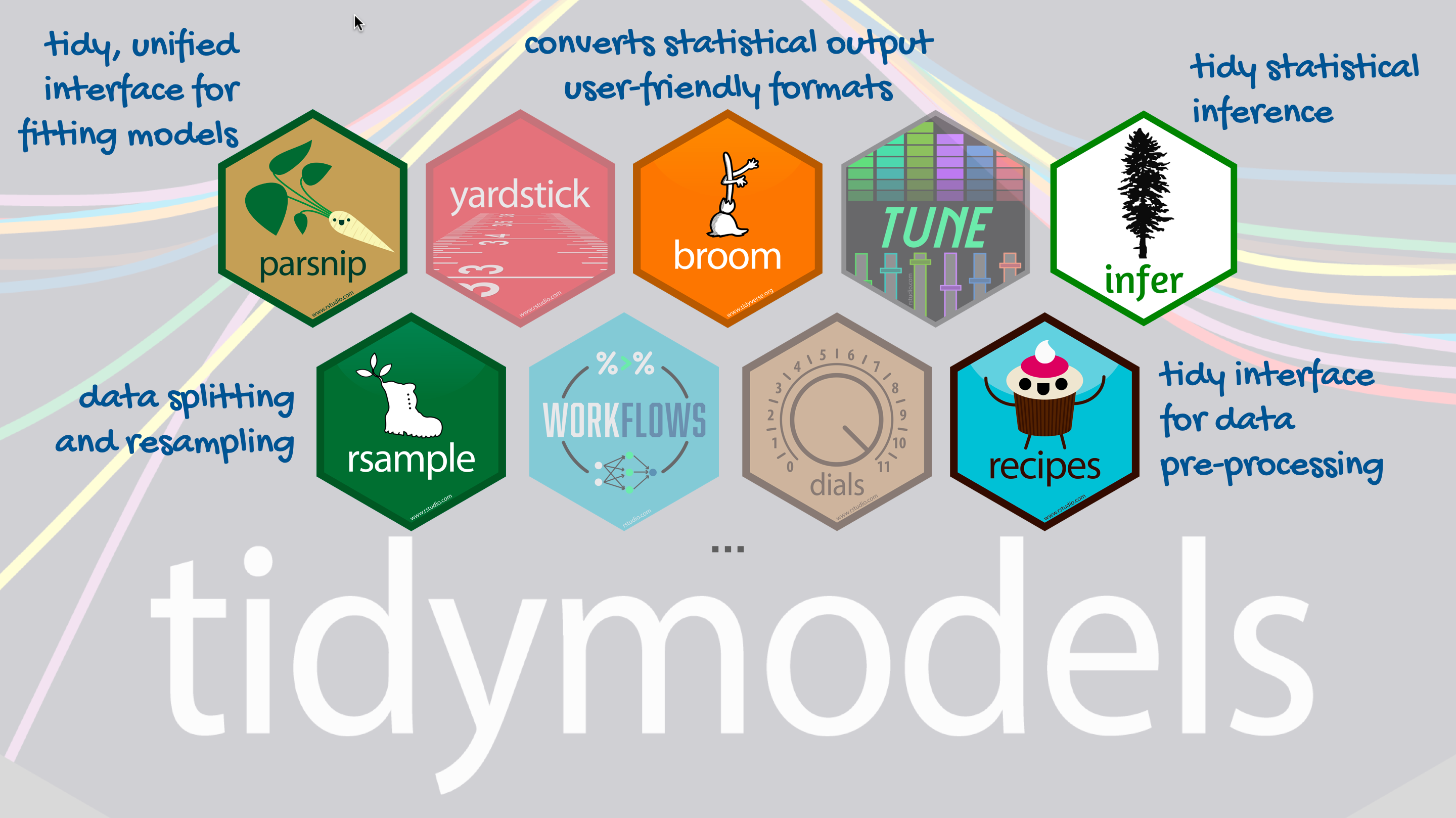
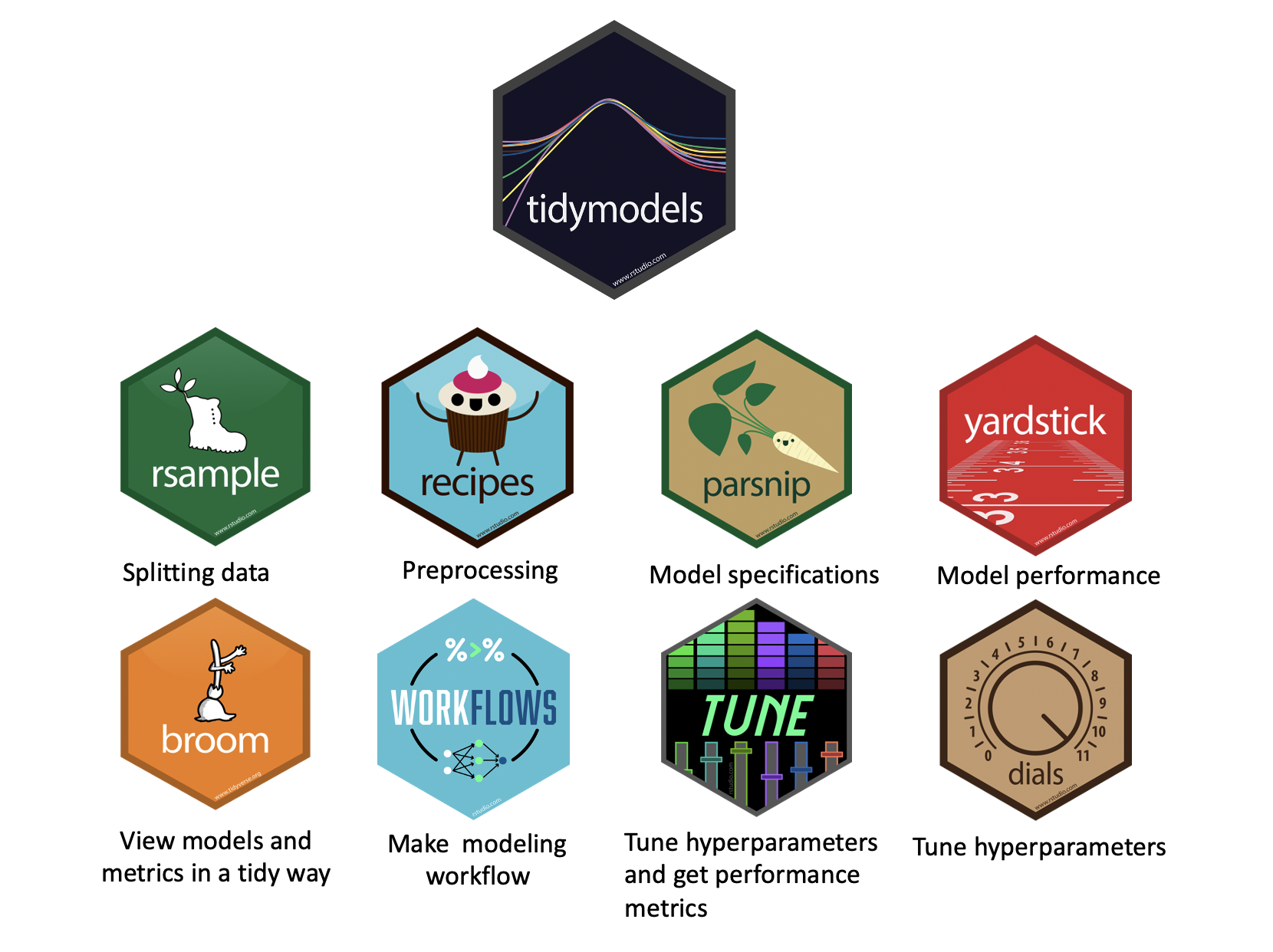
tidymodels: ecosystem
The main packages (and their roles):
Inference: intro
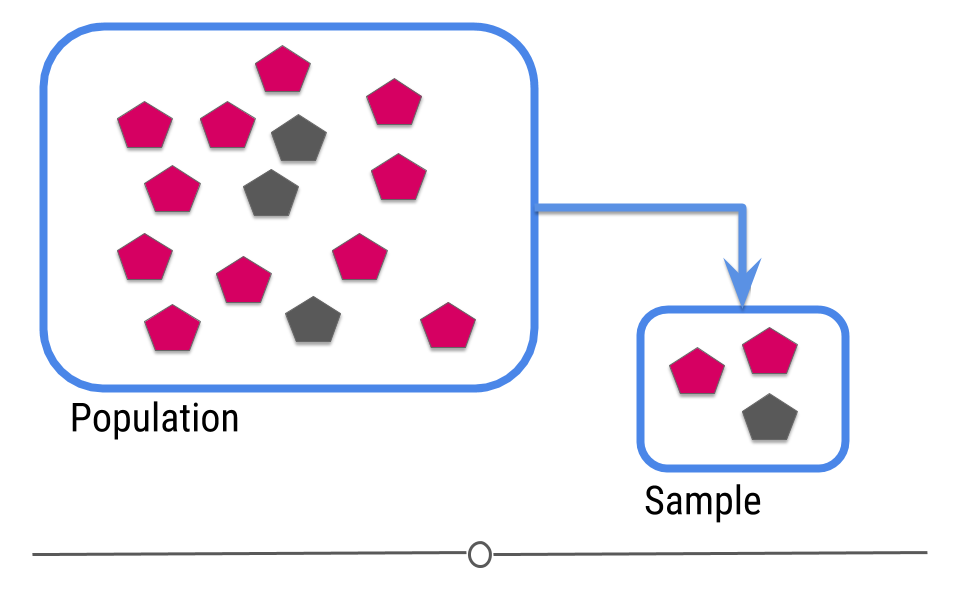
In intro stats, you should have learned the central dogma of statistics: we sample from a population
. . .
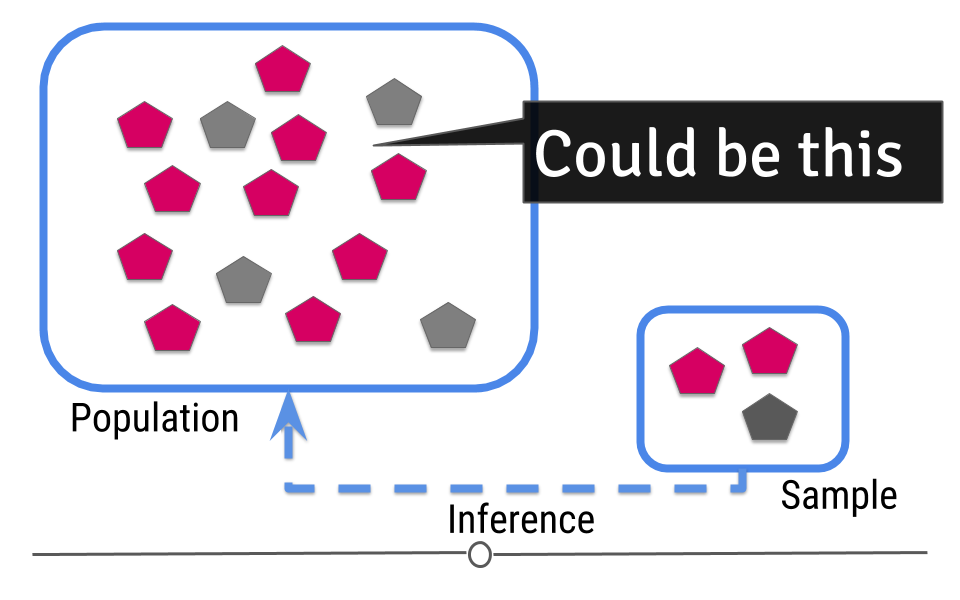
The data from the sample are used to make an inference about the population:
Inference: packages
tidymodels
Not part of tidyverse; load separately
# should already be installed for you on datahub
library(tidymodels)
Step 1: Specify model
linear_reg()Step 2: Set model fitting engine
linear_reg() |>
  set_engine("lm") # lm: linear model
Step 3: Fit model & estimate parameters
… using formula syntax
linear_reg() |>
  set_engine("lm") |>
  fit(outcome ~ predictor, data = df)
A closer look at model output
\[\widehat{outcome}_{i} = \beta_0 + \beta_1 \times predictor_{i}\] . . .
🧠 How do we read/interpret this model?
Slope and intercept
\[\widehat{outcome}_{i} = \beta_0 + \beta_1 \times predictor_{i}\]
. . .
- Slope: For each additional unit increase in the predictor, we could expect the outcome, on average, to be higher, by \(\beta_1\).
. . .
- Intercept: When the predictor is zero, we would expect the outcome to be \(\beta_0\) on average.
ML: intro
For prediction, we have a similar sampling problem:
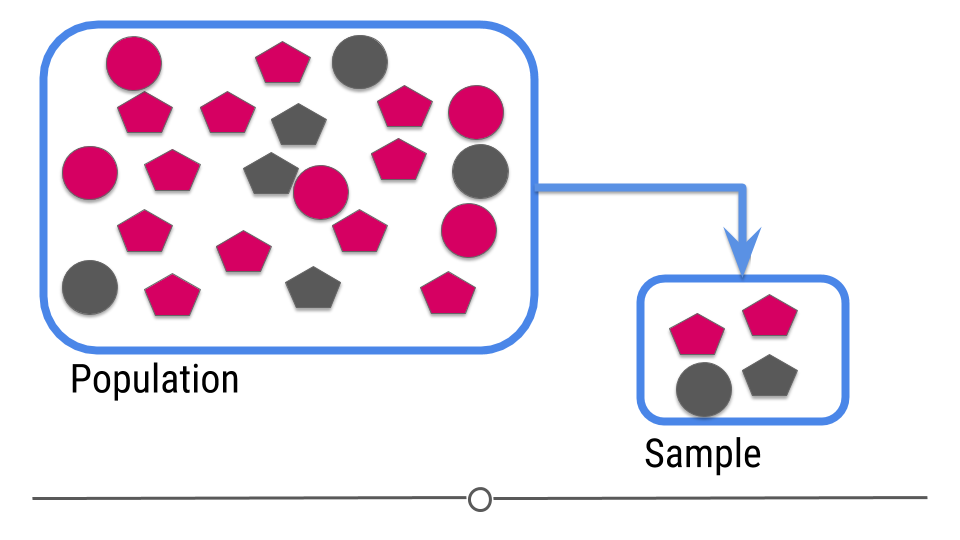
. . .
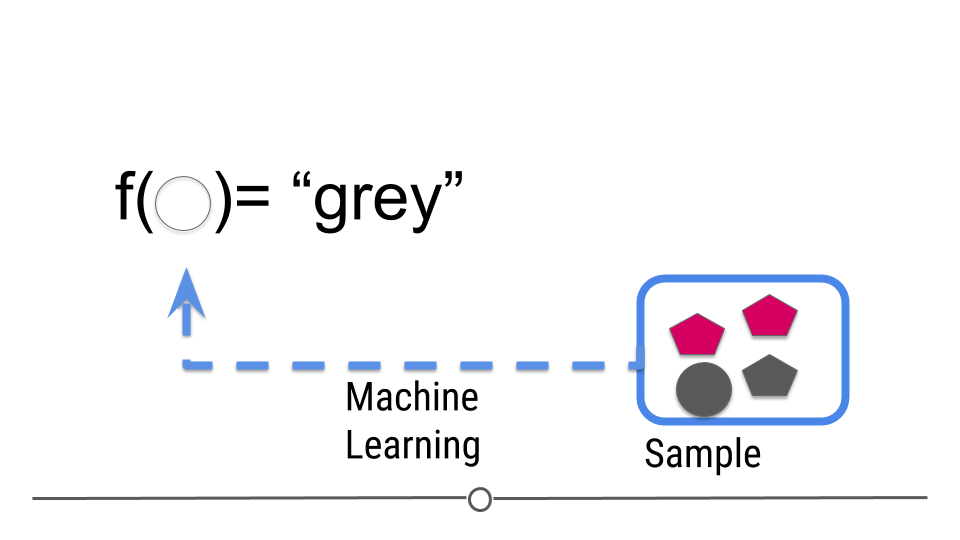
But now we are trying to build a rule that can be used to predict a single observation’s value of some characteristic using characteristics of the other observations.
ML: the goal
The goal is to:
build a machine learning algorithm
. . .
that uses features as input
. . .
and predicts an outcome variable
. . .
in the situation where we do not know the outcome variable.
. . .
🧠 Summarize/Evaluate: How is this similar/different from inference?
Classic ML
Typically, you use data where you have both the input and output data to train a machine learning algorithm.
. . .
What you need:
- A data set to train from.
- An algorithm or set of algorithms you can use to try values of \(f\).
- A distance metric \(d\) for measuring how close \(Y\) is to \(\hat{Y}\).
- A definition of what a “good” distance is.
tidymodels for ML
How these packages fit together for carrying out machine learning:
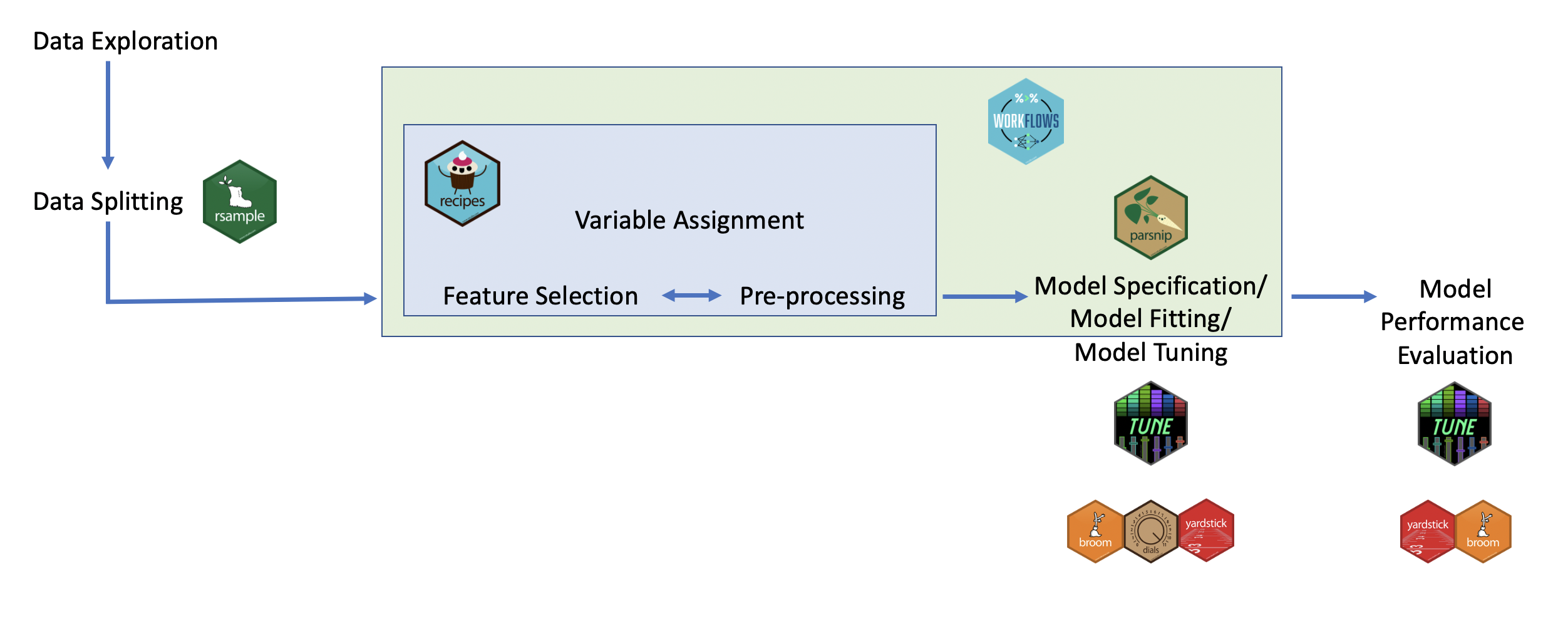
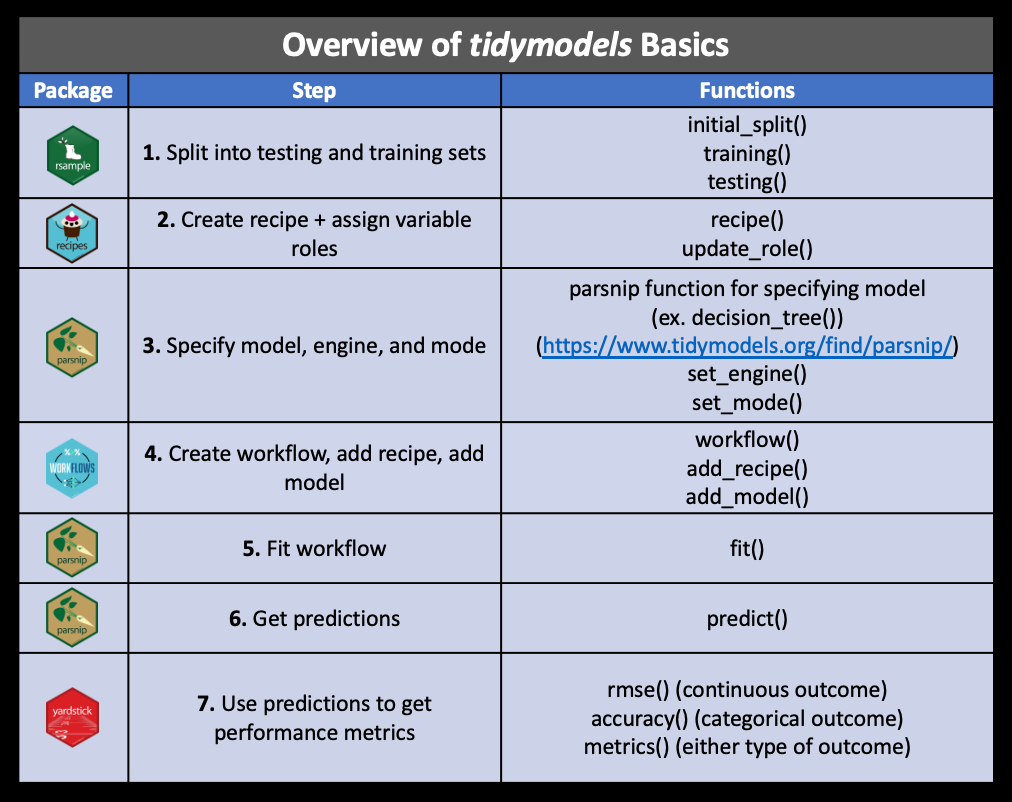
tidymodels: steps
Recap
- Explain what models are used for
- Describe a problem where inference would be beneficial
- Describe a problem where machine learning would be beneficial
- Describe the goals and overall approach to modelling in
tidymodels